Bom Jesus do Monte
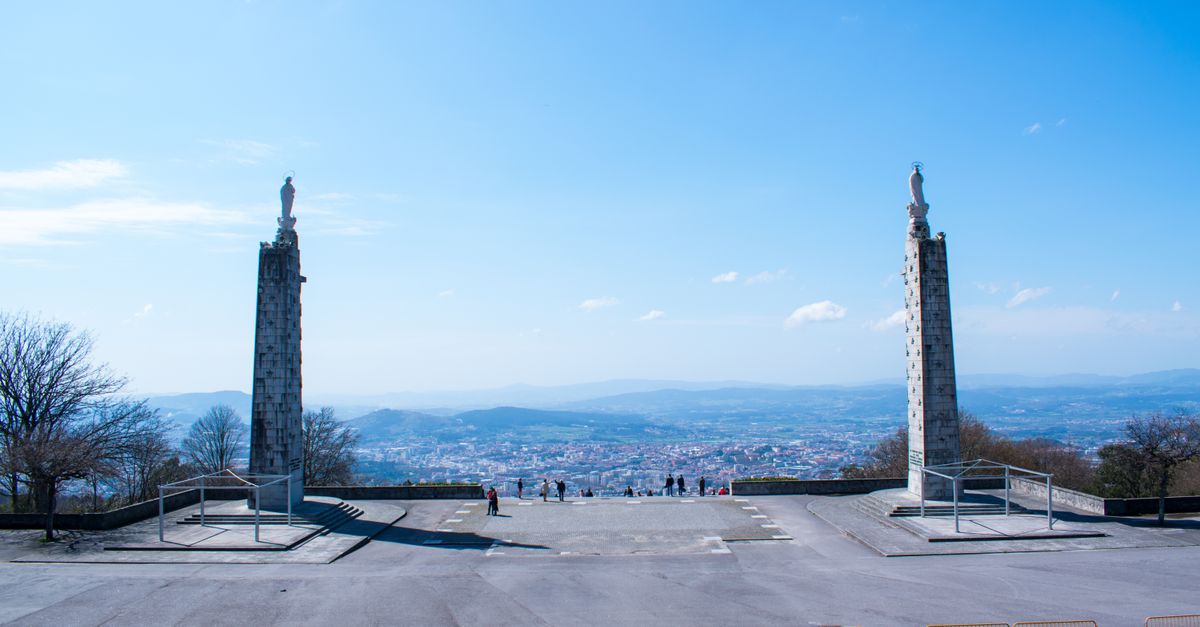
Bom Jesus do Monte is a UNESCO World Heritage sanctuary on a wooded hillside overlooking Braga. The site centers on a Baroque, zig-zagging granite staircase and a 19th-century church.
A logical stop for those studying Baroque masonry or looking for an elevated view of the Braga valley.
Why go
The sanctuary integrates religious art, hydraulic engineering, and garden design. Ascending the Escadório dos Cinco Sentidos involves moving past a series of stone fountains and allegorical statues that lead to the summit overlook.
Why you might skip it
The site requires navigating steep inclines. Those unable to use the funicular or walk long flights of stone stairs will find the layout restrictive. Expect high density during religious holidays and weekends in summer.
What to do
Walk the granite stairs to view the fountains and statues, visit the neoclassical church at the top, and ride the 19th-century water-counterweight funicular.
What to eat
The local offerings near the sanctuary consist of simple, traditional fare found in small cafes located at the base or the hotel terrace at the summit. Typical items include pão de ló, a dense and airy sponge cake synonymous with regional festivities, and espresso served with almond-based pastries. These cafes prioritize convenience over culinary complexity, providing necessary refreshment for those concluding the ascent, but they do not serve as standalone destinations for formal dining.
History & origin
Site development started in the 16th century. The current church and the sequence of stairways were built between the 18th and 19th centuries as a pilgrimage destination.
Getting there & around
5km east of Braga center. Accessible by local bus, taxi, or car; parking is available at the base.
The site moves from the lower funicular station to the upper sanctuary courtyard via steep stone paths and staircases.
Common planning mistakes
Attempting the staircase without water or footwear suitable for uneven, steep stone steps.
Less ideal for
Travelers with limited mobility who prefer avoiding steep climbs, and those who dislike crowds.
Practical notes
Sanctuary grounds are open daily. The water-powered funicular requires a fee. Most of the site is outdoors; monitor local weather before departure.
Where it sits


More history in Porto & North

Clérigos Tower
The 76-meter baroque bell tower that defines Porto's skyline, by Nicolau Nasoni.

Santuário de Nossa Senhora dos Remédios
This 18th-century rococo sanctuary stands above Lamego, noted for its monumental staircase decorated with blue-and-white azulejos. It functions as a pilgrimage site and a study in Baroque landscape architecture.

Capela das Almas
The Capela das Almas on Rua de Santa Catarina is clad in nearly 16,000 blue-and-white azulejo tiles. It documents the regional application of ceramic panels to building exteriors.
Caretos de Podence (Entrudo)
The Caretos de Podence are UNESCO-recognized masqueraders who appear in the village of Podence during Entrudo, wearing fringed costumes and brass bells. The tradition persists as an Iberian pre-Roman custom that alters the routine of this Transmontano village.

Festa de São João (Porto)
Festa de São João is a Porto street festival held on the eve of Saint John the Baptist's feast day. The city streets fill with pedestrians carrying plastic hammers and leeks, leading to a midnight fireworks display over the Douro River.

Guimarães Castle
A 10th-century stone fortification often cited as the origin point of Portuguese statehood.
We may earn a commission from bookings made through these links. It never changes what we recommend, or what we leave out.