Clérigos Tower
The 76-meter baroque bell tower that defines Porto's skyline, by Nicolau Nasoni.
Climb it once for the layout of the city in your head; the queue tells you when everyone else had the same idea.

Why go
Six flights of a narrow spiral staircase buy you the best single orientation view of central Porto — the river, the bridges, the tiled roofs, and the Atlantic beyond.
Why you might skip it
If the weather is overcast or foggy, the climb is not worth the effort as the primary appeal—the city vista—is significantly obscured.
What to do
Ascend the 225 narrow stone steps for a 360-degree panoramic view of Porto and the Douro Valley. Below, explore the accompanying Clérigos Church, featuring an intricate, ornate retable, and visit the museum housed in the Brotherhood's former residence, which contains religious art and artifacts collected over centuries.
History & origin
Designed by the Italian architect Nicolau Nasoni and completed in 1763, the Torre dos Clérigos stands as a landmark of Portuguese Baroque architecture. It was commissioned by the Brotherhood of the Clerics to anchor their church, and for over two centuries, it served as a navigational beacon for ships entering the Douro River, eventually becoming the definitive symbol of Porto.
Getting there & around
The tower sits in the center of Porto and is accessed entirely on foot; do not attempt to drive in the immediate vicinity due to narrow, one-way streets and a lack of parking. It is a short walk uphill from the São Bento train station or the Aliados metro stop.
Common planning mistakes
Attempting to climb during peak midday hours, which often results in long, stationary queues. Another error is failing to appreciate the detailed masonry of the tower's exterior facade before entering, as most visitors focus solely on the ascent.
Less ideal for
Visitors with reduced mobility, small children in strollers, or anyone uncomfortable in tight, enclosed spiral staircases. Those seeking a tranquil, solitary experience will likely find the crowds overwhelming.
Practical notes
Tickets are sold for specific time slots, so booking online in advance is essential to secure entry. The staircase is extremely narrow, making it challenging for those with limited mobility or claustrophobia. The site is located in a high-traffic area, so plan for walking uphill on cobblestones.
More history in Porto & North
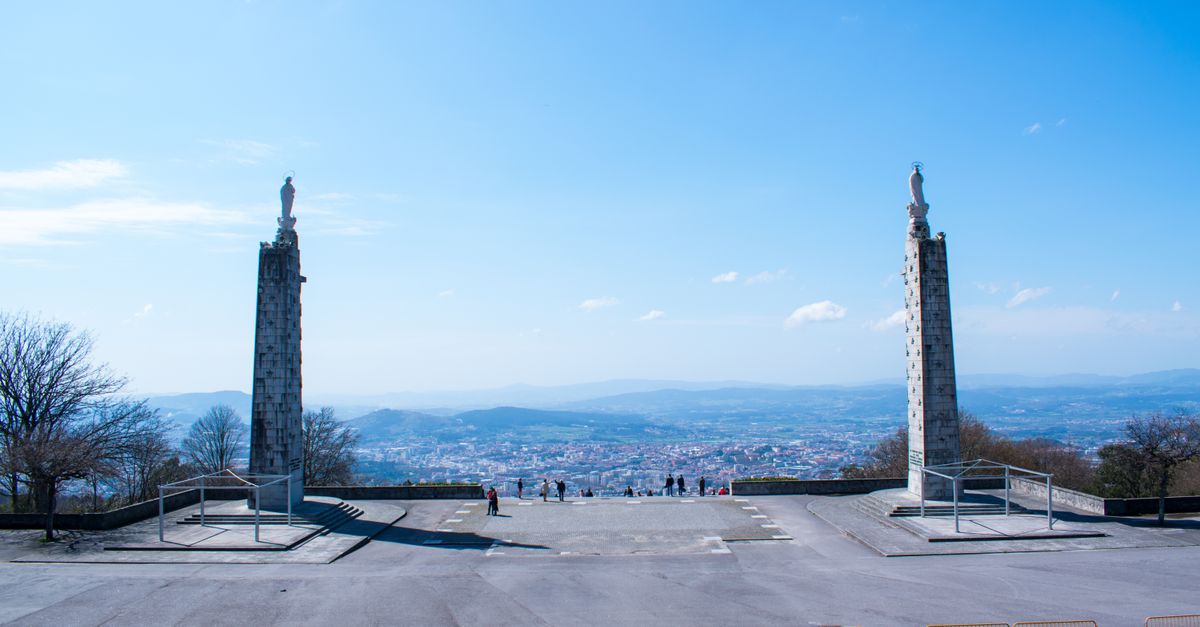
Bom Jesus do Monte
Bom Jesus do Monte is a UNESCO World Heritage sanctuary on a wooded hillside overlooking Braga. The site centers on a Baroque, zig-zagging granite staircase and a 19th-century church.

Casa da Música
Designed by Rem Koolhaas, Casa da Música is a venue for classical and experimental music in Porto. Its irregular, faceted form is a central piece of the city's modern architecture.

Santuário de Nossa Senhora d'Agonia
This 18th-century sanctuary sits above Viana do Castelo, serving as the site for the Romaria de Nossa Senhora d'Agonia festival.

Santuário de Nossa Senhora dos Remédios
This 18th-century rococo sanctuary stands above Lamego, noted for its monumental staircase decorated with blue-and-white azulejos. It functions as a pilgrimage site and a study in Baroque landscape architecture.

Santuário de Santa Luzia
Sitting atop Monte de Santa Luzia in Viana do Castelo, this neo-Byzantine sanctuary provides an elevated vantage point over the Lima River estuary and the Atlantic. The structure serves as a regional landmark, combining monumental religious design with high-altitude views of the coast.

Santuário do Sameiro
Santuário do Sameiro is a prominent Marian shrine situated on a hill overlooking Braga. The site includes a neoclassical basilica and a wide stone staircase that provides a vantage point across the Minho region.
We may earn a commission from bookings made through these links. It never changes what we recommend, or what we leave out.