Massa Sovada
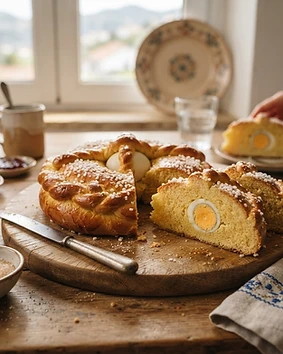
Sweet bread with a halo — the Azores' round, egg-enriched loaf, the centre of the Holy Ghost festival.
The crown jewel of traditional baking, defined by its golden, eggy crumb and structural beauty. It is less a bread and more a monument to hospitality.
It represents the deep historical and religious currents of the Azores, appearing most prominently during the Festival of the Holy Ghost.

Where it comes from
Massa sovada was historically baked in massive communal ovens to celebrate the Holy Ghost festivals, where it was shared among the entire village. The name itself, meaning beaten dough, refers to the rigorous, long-duration kneading required to achieve the correct elasticity. It serves as a vestige of a time when ingredients like sugar and quality flour were precious communal gifts.
The dish
This is a dense, yellow-hued bread made with a high proportion of eggs and lard, resulting in a slightly sweet, chewy loaf. It is often braided or shaped with a halo, reflecting its ceremonial significance in local festivities.
Key ingredients
- 01Wheat flour
- 02Eggs
- 03Sugar
- 04Lard
- 05Milk
When to eat it
Best shared in slices during the weeks leading up to and following the Holy Ghost celebrations.
Why you might skip it
If looking for a low-sugar, savory loaf to accompany a soup, this rich, brioche-like bread will feel out of place.
Good to know
Traditional bakeries in smaller villages are the most reliable source for the authentic, lard-enriched version.
Serve with

Azores
A volcanic archipelago wine region across nine islands, defined by the UNESCO basalt-pen vineyards of Pico, where Arinto, Verdelho and Terrantez make taut, mineral wines from some of the most extreme terroir on earth.

Azores Wine Company
The pioneering Pico estate of winemakers António Maçanita and Filipe Cardoso, reviving serious winemaking on the volcanic island with taut, mineral whites from Arinto and Verdelho grown in the UNESCO basalt vineyards.
Eat


Bolo Lêvedo dos Fenais
A soft, sweet round bread, split and toasted — the Azores' everyday bread and breakfast.


Cozido das Furnas
A meat-and-vegetable stew cooked underground by volcanic steam — the Azores' most theatrical dish.


Cracas
Barnacles picked from the rocks and eaten raw or briefly cooked — the Azores' most hardcore seafood snack.
Where to find it

Azores
Nine volcanic islands in the mid-Atlantic — calderas, crater lakes, whales, hot springs, and green so green it has its own color ('azul').

Pico
The mountain island — Portugal's highest peak, vineyards grown in black lava, and a wild, black-rock coast. The Azores for the adventurous.