Évora
A walled university city in the Alentejo plain — Roman temple, bone chapel, whitewashed streets, and the regional capital of slow, serious food and wine.
The essential Alentejo base. Pair it with the marble villages and a wine estate.

Why go
The Roman Temple, the Cathedral, the Évora University, the Bone Chapel, and a dense, walkable walled center surrounded by cork and vine. The food and wine scene is among Portugal's best.
Why you might skip it
Inland and hot in high summer; if you only want coast, the Alentejo isn't your region.
What to do
Roman Temple, the Cathedral and its terrace, Évora University, the Bone Chapel, a wine estate visit, the Alentejo food scene.
What to eat
Açorda, migas, porco preto, game, Alentejo wines; eat at a slow-food tasca.
Where to stay
Inside the walls for walkability; a wine estate (quinta) nearby for splurge.
Getting there & around
Train or bus from Lisbon; car via A6.
Walk inside the walls; car for the surrounding villages.
Common planning mistakes
One night; never leaving the walls; skipping the marble villages nearby.
Less ideal for
Beach-only trips; peak-summer heat-avoiders.
What's here

Mercado Municipal de Évora
The Mercado Municipal de Évora is a vibrant hub of Alentejan commerce, where local farmers and artisans showcase the region's prized agricultural output. It serves as the daily heartbeat of the city, offering a raw and authentic look at local food culture far removed from the surrounding tourist corridors.

Taberna Típica Quarta-Feira (Évora)
Taberna Típica Quarta-Feira is an iconic, no-menu institution in the heart of Évora that offers an intimate, chef-led tour of authentic Alentejan home cooking. It captures the soul of the region through slow-cooked traditions and communal, warm hospitality.

Anta Grande do Zambujeiro
Anta Grande do Zambujeiro is one of the largest and most impressive megalithic dolmens in Europe, standing as a monumental testament to Neolithic civilization. Its massive granite stones provide an awe-inspiring glimpse into the funerary practices of prehistoric Iberia.

Cromeleque dos Almendres
Dating back to the 6th millennium BC, Cromeleque dos Almendres is the most significant megalithic site on the Iberian Peninsula. Its ensemble of nearly 100 granite monoliths arranged in a deliberate pattern provides a profound, tangible link to the Neolithic era.

Templo Romano de Évora
Perched in the heart of Évora’s historic center, this remarkably preserved 1st-century Roman temple stands as a testament to the region's ancient Lusitanian roots. Its iconic Corinthian columns serve as the defining visual anchor of this UNESCO World Heritage city.

Sé de Évora
The Sé de Évora is a formidable 13th-century granite fortress-cathedral that stands as the most important religious monument in the Alentejo. Its unique fusion of Romanesque and Gothic architecture makes it a defining silhouette against the Évora skyline.

Igreja de São Francisco
The Igreja de São Francisco is a stunning example of Gothic and Manueline architecture, most famous for its unsettling yet fascinating Capela dos Ossos. It stands as one of the most iconic landmarks in the historic heart of Évora.

Capela dos Ossos
This haunting 16th-century chapel, attached to the Church of Saint Francis in Évora, is famously lined with the bones and skulls of thousands of monks. It serves as a stark, memento mori meditation on the transience of life.


Açorda Alentejana
A bread, garlic and olive oil mash with a poached egg — the Alentejo's defining humble dish.


Migas com Carne de Porco
Bread mash with pork and its fat — the Alentejo's answer to nothing being wasted.

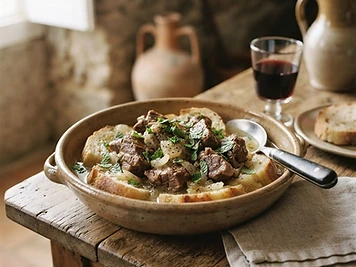
Ensopado de Borrego
Lamb braised in bread broth — a festive Alentejo stew of the interior hills.

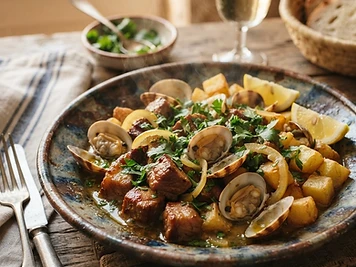
Carne de Porco à Alentejana
Pork and clams together — the Alentejo's most famous surf-and-turf, despite debate over its origin.


Sopa de Cação
Dogfish in a garlic-coriander bread soup — the Alentejo's coastal-and-interior fish stew.


Pão de Rala
A tube of egg-yolk cream wrapped in squash jam — Évora's celebrated convent sweet.


Torresmos à Alentejana
Cubes of pork skin and fat fried crisp — the Alentejo's most addictive petisco.
Where it sits